This work was published in The Avenue Journal, Issue X: Dogs
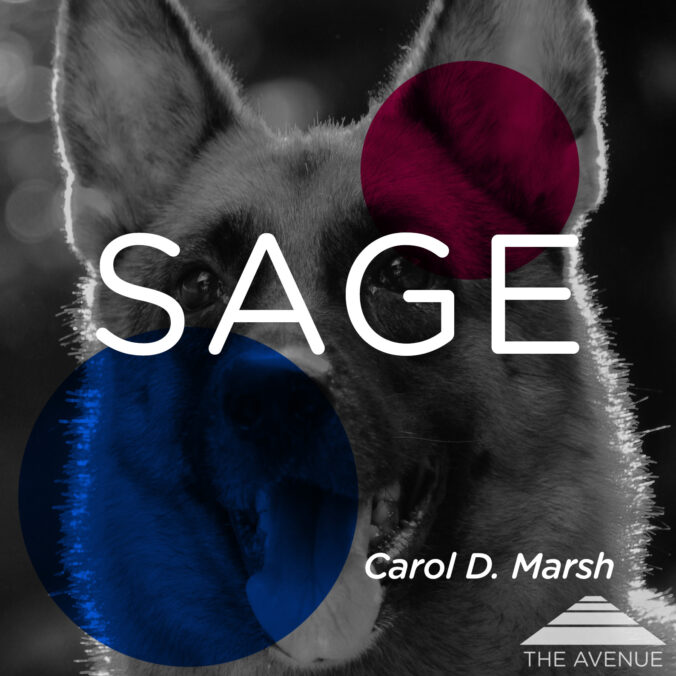
Sage
by Carol D. Marsh
I want to tell you about a woman and a dog.
The woman, my mother. The dog, her German Shepherd, Sage.
Mom was eighty-one when Sage came to her. Sage was two.
I’ll start toward the end, when they’re both ten years older. I want you to feel you’ve met Sage before you know how this story begins.
At 90, Mother had several injurious falls and had to move from her suburban home to a retirement community. There, Mom and Sage made a life near as possible to their previous one. Sage had loved to run down the driveway to fetch the newspaper, so Mom threw a rolled, banded paper around the apartment, tossing it into each of the three rooms for Sage to fetch. After a while, it left slobbery bits of paper stuck to the carpet. No matter. Sage loved that raggedy newspaper so that newspaper was what she got.
Mom was still falling. She put the cane aside for a walker and stopped doing outdoor walks. She could let Sage outside to the tiny yard off her patio, but fretted the dog wasn’t getting real exercise. Her solution was to take Sage—who heeled perfectly, walker or not—when she traveled the hallways to her mail box, and to play canasta and Bingo. Returning, she’d unclip Sage’s leash at the top of the hall, and the happy dog would prance and leap to the unlocked apartment door, push it open and enter. It would swing shut behind her, but she’d turn right around and press her nose to the space between the door and the jamb, snuffling loudly until Mom got there, and so happy to see her that she crowded the door, all wagging tail and eager whines. Mom had to use her obedience-training voice to get the dog to back up so Mom could get in.
For all her playfulness, Sage was a serene dog. To walk with her around Mom’s retirement community was to know how it might feel to be in the entourage of royalty. No one paid attention to the person at the end of the leash, so drawn were they to this gentle being who greeted all with quiet acceptance. They delighted to sink their hands in her luxuriant, soft fur, or scratch behind her ears while Sage wagged her tail, lifting her muzzle to their faces in case they got closer and she could give them a kiss. When we happened to be out without her, they’d demand to know, without so much as a hello, where Sage was.
A certified therapy dog, she’d stop to lick the hand of anyone in a wheelchair, she’d pull toward every open door on the health care wing because her job—though she was twelve and her hind legs, eyes, and ears were failing—was to find the alone and the ill and pay them kind attention.
I met Sage a week after my mother rescued her from the kennel of a breeder who’d become too ill to care herself, let alone her dogs. Mom had decades of obedience-training German Shepherds, but was in her late seventies, frailer, and beginning to have trouble walking. I wondered if she could manage all that would come with a new, untrained, two-year-old Shepherd.
I didn’t know the half of it.
The poor dog was emaciated, every bone visible under her mangy, rough pelt. Worse, she was out of control. Sudden freedom, a strange home—Sage acted terrified. Though I was deeply distressed for her, I was more upset by the situation’s inherent danger for Mom and her shaky legs.
Mom had to leash Sage, who had never been leash-trained, before taking her out. The agitated animal fought and whirled, pulling my mother nearly off her feet every few seconds during the trip through the porch, across the patio, and down three steps onto the yard. It was no easier on the way back. Sage seemed intent on being somewhere, anywhere, other than where she was, including inside her own skin.
Mealtimes were, if anything, worse still. When Sage smelled food she’d become so unhinged Mom couldn’t restrain her. She had to wrestle the dog into her crate in the family room before cooking anything for herself and before preparing Sage’s meal. The ever-hungry animal, hearing the preparation and smelling her food, would slam back and forth against the crate’s metal frame, howling. After Mom had put the bowl on the kitchen floor, she’d open the crate and stand well back while Sage lunged forward, scrabbled to the kitchen, and bolted her meal down in seconds.
My concern for this suffering being became fear for my mother, who lived alone. I pictured Sage knocking her over, Mom incapacitated with a broken hip or leg, and help long in coming.
This is the end, June 2023: Sage is fourteen, with typical Shepherd hip dysplasia and legs so weak she often stumbles, needing help righting herself. Finally, we can no longer ignore the physical toll of that fishtailing, painful gait. My mother, at what heart-cost I cannot bear to contemplate, makes the decision to have her companion put down.
This is the story about a woman and a dog.
It’s about the dog who kept the woman on her feet though her legs shook and her balance wavered. It’s about the woman who revealed the best of the dog, glory once nearly erased by neglect and starvation. It’s about my mother, who never, ever gave up on Sage, and Sage, who never, ever stopped trying for my mother.
Maybe this story originates in happenstance. You may think it lucky they found each other in that lottery twelve years before. I’ve come to believe, however, that Mom was meant for Sage and Sage was meant for Mom. I believe that what they became together was astounding, and what happened between them nothing less than the miracle of love.
Carol D. Marsh lives in Washington, DC, and earned her MFA from Goucher College. She’s won essay awards from New Millennium Writings (Winner), Under the Gum Tree (Hon. Mention), Solstice Literary Magazine (Finalist), and Tucson Book Festival (Winner). Other essays have appeared in Los Angeles Review’s Best of Annual, River Teeth, Chautauqua Journal, and The Vassar Review, among many others. Marsh’s book, Nowhere Else I Want to Be: A Memoir, was a Finalist (Memoir), Sarton Women’s Book Award 2018, and the Finalist, National Indie Excellence Awards 2017 (Memoir). Her chapbook, Border/Between: A Symphony in Essays, was released by Bamboo Dart Press in June 2022.
You can purchase The Avenue Journal Issue X: Dogs in paperback at Bookshop.org, or, if you prefer it in digital format, you can download the ebook in .epub format for pay-what-you-can (suggested donation $9) at ko-fi.